Showing posts with label Anti-VM. Show all posts

Monday, March 23, 2015

Latest Updates of VxStream Sandbox and the Malware Analysis Service at Hybrid-Analysis.com

A previous blogpost published at the beginning of February outlined some of the new features that were added to our online malware service. We have added quite a lot of functionality since then and think it is a good idea to post a brief summary of what that is exactly to keep our readers and users up-to-date.


Updated Anti-VM Technology

After Pafish v0.4 (a benchmarking tool that implements common VM detection methods) was released earlier this year, we updated our anti-vm technology to be up-to-date and made a small benchmark of some popular malware analysis services at the same time. Today, Pafish v0.5 was released and we will start working on our anti-vm technology in the coming weeks and keep you updated on any progress.


Improved Searching Capabilities

We improved the webservice search and added some more advanced search options. On the previous version, you were able to search by filename, MD5 or SHA256 hash. Now, you can also search for a virus family name, all reports that contacted a specific host IP address or domain. Examples:
Please note: if only one result is returned by the search, you are automatically redirected to the report. Also, the vxfamily search is a substring search and applies only to the VxStream determined virus family name. All search results are limited to at most 100.

Also, some of the new searching capabilities were integrated into all online reports with direct links, so you can continue navigating to other reports by clicking the virus family name or quickly find other reports with common network destinations (see the following image).


Updated VBA Macro Parsing

As we had been getting more and more uploads of Word files and malicious XML files (and not all of them triggered or showed outgoing network traffic), we spent some time and added a small VBA "de-obfuscating" engine that helps extracting C2 IPs regardless of the runtime behavior. We made a blogpost about it last week that received good feedback and is showing some good results so far. After we published the blogpost, Philippe Lagadec announced that he is working on a generic engine that does the same and more - so we are looking forward to that development and will keep you updated on any progress.


Other updates not mentioned anywhere

Of course, we also make updates that are not published as part of blogposts or mentioned in the FAQ page of the service, because it would take too much time and not everything is really significant. Some of these updates over the past week included:
  • we added new YARA signatures that run on all input samples (we have ~600 online right now)
  • we have been adding more generic behavior signatures (we have ~215 online right now)
  • we added a webservice statistics page to clean up the front page, which tells you the current status of the number of signatures loaded by the system
  • we added support for MIME types (i.e. you can upload a MIME type and the service will "unmime" it and analyze a valid file, if it is embedded)
  • we added "environment groups" (multiple systems) that can be selected from if you upload a file
  • we added some Windows 8.1 VMs
  • we added the ability to "not share" a sample when submitting (it is not available for download and not uploaded to VirusTotal, if unknown)
  • we added a download for strings detected in-memory
  • we added shellcode streams that are extracted from memory written to foreign processes
  • we brushed up the visuals a bit, especially the submissions list that contains a lot more information now
.. and a few other minor things that should not be mentioned here.

Sunday, February 22, 2015

Benchmarking some popular public malware analysis services regarding their "Anti-VM" technology

While checking submissions on our webservice we discovered that someone uploaded a "new" version of Pafish (by a0rtega). Pafish is a demo tool that performs typical anti-VM tricks in use by common and sophisticated malware. The new version of Pafish adds a lot of new VM and system trace checks, especially for VirtualBox. As is known, VirtualBox happens to be the default analysis environment of most sandboxes (including Cuckoo Sandbox's Malwr service and our own Hybrid-Analysis.com's free malware analysis service).

To be honest, the new version of Pafish did detect our virtual machine environment using some of the new methods - and it is impossible to prevent all types of detections ahead of time. More importantly, it is necessary to stay on top of the game and offer a software product that is agile and can adapt quickly. That is one of the principles we try to live up to and thus we always try to improve quickly and update VxStream Sandbox when necessary. A benchmarking tool like Pafish is a perfect development tool, because it's a very straightforward, comparable and easy way to stay on par with typical anti-VM methods. On a side note: the "new" release of Pafish is actually not that new, it was released at the beginning of this year - i.e. it's about two months old. One would think that well established and well known sandbox systems like Malwr, ThreatTrack or Comodo would have adapted by now - but to our surprise this is not the case.

First of all, this is how it should look if you run Pafish v0.4 (current state of VxStream Sandbox):


The green "OK" indicates that the specific check was passed and Pafish was not able to detect that it is running on a virtual machine. Here is one full report of VxStream Sandbox on our webservice (we copied the different console outputs into one screenshot to save space).

This is how the instance of Cuckoo Sandbox running on Malwr performed:


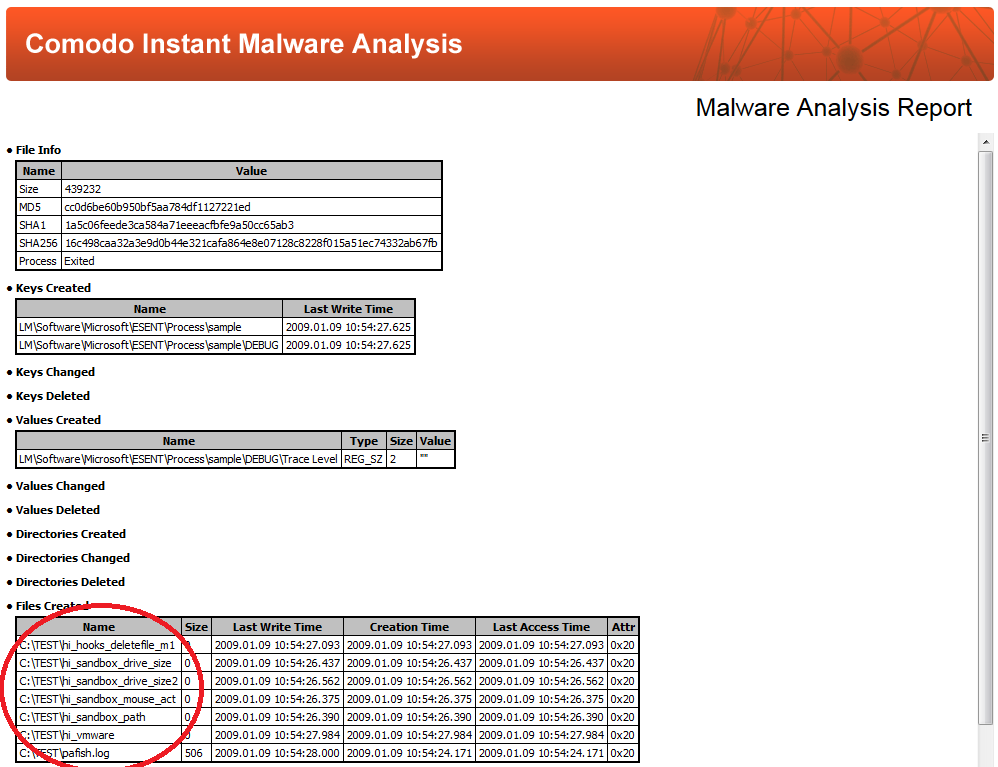
This is how Comodo Instant Malware Analysis performed:


The created "hi_" files indicate detection.

This is how ThreatExpert performed (it seems to be using VMWare as environment - and those checks are very old):


Sadly, Anubis failed to even parse the file, but to their defense the service is not being actively maintained it seems:


Finally, let me quote from ThreatTrack's main page before finishing up with this blogpost:

"Our solutions detect the world's most sophisticated malware – including Advance Persistent Threats (APTs) and targeted attacks – and empower you to completely eliminate those threats from your network."

I am assuming that "the world's most sophisticated malware" does not include simple VM checks *grin*. Nevertheless, I would like to underline that we are not claiming to include the "best anti-VM technology" possible (and that's a big difference to other malware analysis vendors), but at least we try to get the basic homework done. Big vendors that claim they include "high-end technology" should be doing the same (taking care of their homework) and spend less money on marketing bla-bla. Of course, it is a bit unfair to mention Cuckoo Sandbox with its malware service Malwr in this context, because it is based on an open-source tool, but I added it for completeness sakes, as it is the most popular free malware analysis service available.

Update (03/23/15): One of the Cuckoo Sandbox authors complained to us last week that they never claimed to have anti-vm technology included in their sandbox system, which might be true for the sandbox system itself, but this blogpost is focusing on public online services only (which is why we now updated the blogpost title, it might have been a bit inaccurate before), their output and not theoretical capabilities of the tools behind the services. The assumption that an online service demonstrates the latest and greatest version and capabilities of a sandbox system is valid one in our eyes, because a user probably expects an online service to try to analyze malware as good as possible, at least when it is about important aspects of malware analysis.